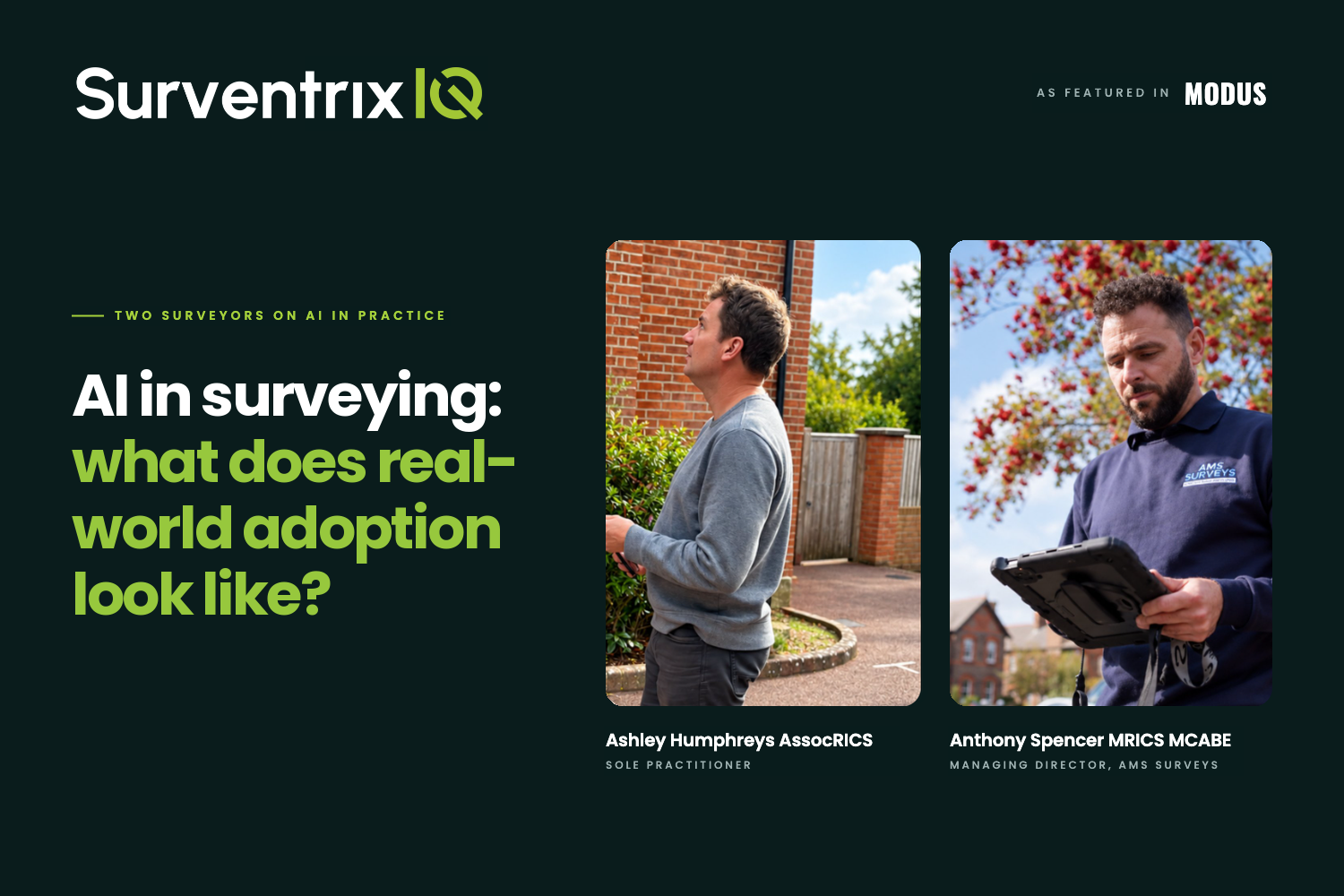
We're proud to share that Surventrix has been featured in RICS Modus, with an article exploring how surveyors are actually using AI in practice, eight months on from the new RICS standard coming into force.
Written by Ian Hughes, Marketing Manager, and Ryan Oakes AssocRICS, Head of Sales at Surventrix, the piece moves past the hype and hears directly from two surveyors using AI every day: Ashley Humphreys AssocRICS of A&H Surveying, and Anthony Spencer MRICS, Managing Director of AMS Surveys.
Read the full article on RICS Modus
The question has changed
The RICS professional standard Responsible use of artificial intelligence in surveying practice took effect on 9 March 2026. It is mandatory, and it shifts the conversation from whether surveyors should use AI to how they use it without compromising professional standards.
Under the standard, surveyors need to understand the limitations of the AI tools they use, record a written reliability decision on any output that materially affects their service, and tell clients in writing, in advance, when AI plays a material part.
The sole practitioner: Ashley Humphreys AssocRICS
Ashley is a residential building surveyor and sole practitioner in East Sussex. He dictates his site notes, and AI turns them into draft report sections. His reporting time has fallen from around five hours to between 1.5 and 2 hours per report.
But Ashley is clear that the surveyor stays in charge. If the output is wrong, it's his job to correct it, and good results depend on good data combined with a surveyor's own knowledge. His advice to anyone considering AI is simple:
"Try it and see. It's there to help you, not to do your job."
The practice owner: Anthony Spencer MRICS
Anthony runs AMS Surveys, an SME practice in Liverpool. He started experimenting with general-purpose AI around two years ago, before choosing a platform built specifically for surveying to roll out across the firm. A practice-wide pilot is now underway, with the aim of giving his surveyors more time with clients.
For Anthony, the technology was the easy part:
"The difficulty has come from bringing the team with us."
His advice to other firm owners is to start the conversation with surveyors early, run pilots, and take time to understand how each person works. And he's firm on one thing: a second set of eyes on every report isn't going anywhere.
Where they agree
Despite running very different businesses, Ashley and Anthony reached the same conclusions:
Professional judgement matters more with AI, not less. The surveyor assesses every output and remains accountable for it.
AI changes how you inspect, not just how you write. Both found their approach on site evolving alongside their reporting.
Adoption is cultural. Getting people comfortable and confident takes longer than switching on the software.
Transparency with clients is essential. Terms of engagement should explain when AI is used and whether clients can opt out.
How Surventrix supports responsible AI use
The RICS standard asks surveyors to evidence how AI has been used and who has checked the work. Surventrix is built with that in mind.
Every time Surventrix AI is used, the platform keeps a full audit trail of the inputs, the outputs and who used it, so it's always clear what was and wasn't AI-generated. Report sign-off is recorded in the case log, including second-surveyor sign-off for junior staff.
Those records support supervision and quality assurance. They don't replace the surveyor's own written reliability decision, and they're not meant to. Our IQ Assistants, Writer IQ and Vision IQ, are designed to work alongside your judgement, letting you work your way with your phrase library, dictation or free type.
See it for yourself
We're Expert Partner at the RICS Technology & AI Summit in London on 30 November 2026. If you're attending, come and talk to the team about putting AI to work responsibly in your practice.
Can't make it? Book an online demo with Ryan Oakes and see how Surventrix fits the way you survey.