Surveying at scale: What changes when a surveying Firm starts to grow?
Growth is good. But as a surveying practice grows, the way the business needs to operate changes with it.
A system that works perfectly well for one surveyor can begin to feel very different when there are five people using it. At ten, consistency starts to matter. At twenty, management visibility becomes increasingly important. And when a business reaches forty, fifty or more surveyors, seemingly small inefficiencies can multiply across hundreds of instructions.
The challenge isn't simply processing more surveys.
It's building an operation that can handle more people, more clients, more instructions and more complexity without losing the flexibility and professional judgement that made the business successful in the first place.
That is surveying at scale.
The systems that work when you're small
When you're a sole surveyor, you can be remarkably efficient without much infrastructure.
You know which enquiries have come in. You know which inspections are booked. You know which reports need completing. You probably remember the conversations you've had with clients and agents.
In many respects, you are the system.
And there's nothing wrong with that.
Even as the first few people join the business, informal processes can continue to work remarkably well. A conversation across the office, a spreadsheet, an email or a message might be all that's needed.
But eventually something changes.
Information can no longer live in people's heads.
The question becomes:
Who's doing which survey? Has the client paid? Has the report gone out? Who last spoke to the agent?
As the team grows, communication stops being informal and starts becoming operational infrastructure. That's exactly the transition your scale campaign identifies between one and five surveyors.
As the team grows,
the challenge changes.
You know where everything is.
Information can't live in people's heads.
Different surveyors. One standard.
You can't manage what you can't see.
Then consistency becomes the challenge
Adding surveyors doesn't simply increase capacity.
It introduces variation.
Different surveyors naturally have different levels of experience, different working styles and different ways of communicating findings. That professional judgement is valuable and shouldn't be engineered out of the process.
But the business also needs consistency.
Clients should receive the right information. Reports should meet the firm's standards. Required questions shouldn't depend on somebody remembering to ask them. Processes shouldn't exist only as knowledge held by the most experienced member of the team.
This is where good technology becomes less about making an individual surveyor faster and more about embedding knowledge into the way the whole business works.
Pinnacle Surveyors provides a good example.
Pinnacle uses a wide range of templates within Surventrix, with individual client requirements built directly into them. Rather than expecting every surveyor to remember what every client requires, the relevant questions are presented as part of the workflow. The result, according to Pinnacle, isn't simply speed: it's quality, consistency and fewer queries or amendments afterwards.
That distinction matters.
Scaling isn't about forcing every surveyor to work identically. It's about creating consistency around the things that need to be consistent.
At 20 surveyors, visibility matters
As a surveying operation becomes larger, another problem emerges.
Management can no longer rely on simply knowing what's happening.
What's coming into the business?
What's converting?
Who has capacity?
Which reports are outstanding?
Where are instructions getting stuck?
Which teams or offices are performing well?
Where is additional support needed?
At this point, the system isn't simply a place where surveyors produce reports. It becomes part of the management infrastructure of the business.
And that's a fundamentally different requirement.
You can't manage what you can't see.
When small inefficiencies stop being small
Imagine a process adds just five unnecessary minutes to an instruction.
For an individual surveyor, that may barely register.
Multiply it across hundreds or thousands of instructions and it becomes a business problem.
The same applies to duplicated data entry, chasing information, moving information between systems, correcting reports, checking whether processes have been followed or trying to establish the latest status of a case.
At scale, friction multiplies.
That's why growing firms often don't suffer from one dramatic technology failure.
Instead, they accumulate:
More spreadsheets.
More workarounds.
More duplicated administration.
More disconnected software.
More complexity.
Your existing campaign makes this point particularly well: growth doesn't break the surveying business; it exposes systems that weren't built to grow with it.
40+ surveyors: flexibility versus control
Because a larger surveying firm needs control – but too much control can be just as problematic as too little.
Surveyors still need to be surveyors.
They need professional judgement. They need flexibility. They need software that helps them rather than forcing them through cumbersome processes designed primarily for management.
But leadership also needs consistency, compliance, visibility, quality control and management information.
Joe Miller, CEO of Home Surveying, describes that balance neatly:
“With over 40 surveyors producing reports, you simply can’t have chaos. Surventrix gives us the balance between giving surveyors flexibility and maintaining consistency across the business.”
That may be the real technology challenge of surveying at scale: giving the business greater control without making life harder for the surveyor.
Ask whether it will still work for the business you're becoming.
One system doesn't have to mean one way of working
There's another misconception worth challenging.
Standardisation doesn't necessarily mean rigidity.
Pinnacle currently manages 85 offices through Surventrix. Postcodes, panels and instruction requirements can be controlled within the platform, while instructions can still move between offices when required. Management can also see what's happening on individual cases and track who has updated or worked on them.
That is a useful illustration of what scalable software should actually do.
It shouldn't make a growing firm reorganise itself around the limitations of the technology.
The technology should accommodate the structure of the business.
What should a surveying platform provide as you grow?
Whether you're a sole surveyor with ambitions to build a team, an established regional practice or an organisation operating across dozens of offices, there are some useful questions to ask of your technology:
Can it support more users without creating more administration?
Can knowledge and client requirements be built into workflows?
Can surveyors retain professional flexibility?
Can management see what's happening without constantly asking the team?
Can different offices, teams, panels and instructions be managed centrally?
Can reporting standards and compliance be maintained as volume increases?
Can new technology – including AI, video and automation – become part of the same workflow?
And crucially: will the platform continue adapting as the business changes?
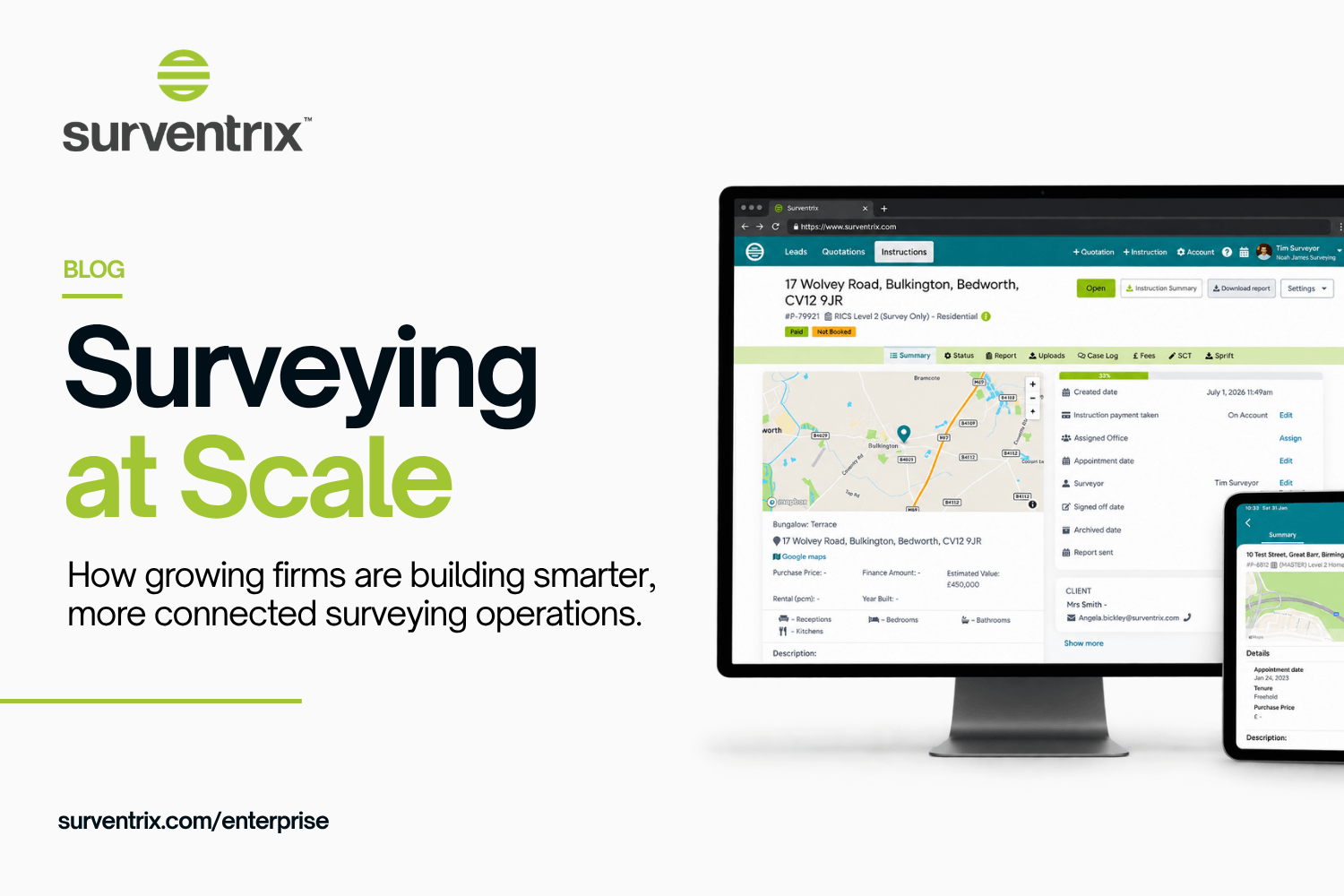
The Surventrix Enterprise proposition brings CRM and leads, quotes and payments, teams and allocation, reporting, AI and video, and compliance into one connected platform – from first enquiry through to final delivery.
But the principle applies regardless of whether there is one surveyor or one hundred:
Technology should remove complexity, not create it.
Growth doesn't have to mean more complexity
A growing surveying practice will inevitably become more sophisticated.
That doesn't mean it has to become more complicated.
The firms that scale successfully aren't necessarily those with the most systems. Often, they're the ones that have thought carefully about how information moves through the business, where knowledge sits, what needs standardising and where people need flexibility.
So perhaps the question to ask about your surveying software isn't:
“Can it do the job today?”
It's:
“Will it still work for the business we're becoming?”
Built for the surveyor.
Ready for the surveying business.
See how Surventrix brings your operation together in one connected platform – from first enquiry to final delivery.
Explore Surventrix Enterprise →